Showing posts with label Review. Show all posts
0 com

Year of the Rabbit by Tian Vesna

Author and cartoonist Tian Veasna was born in 1975, three days after the fall of Phnom Penh, the Cambodian capital. His parents and the rest of his extended family were evacuated by the victorious Khmer Rouge amid rumors that the city was going to be bombed by American forces. As the new regime’s tanks roll into the city, his parents and extended family narrowly escape random checks by over-exuberant soldiers. Veasna’s family are members of the business and professional class—the sworn enemy of the Khmer Rouge, who are mainly peasant farmers.


Outside the city, the family, like many others, has a route set out to leave the country. On their way, Khmer Rouge soldiers usher them aboard a boat to cross the lake. A family acquaintance steps in at the last moment and stops them. Veasna’s family later learns that every day the boat, loaded with bureaucrats and intellectuals, returns bloodstained and empty to port.


Further on their route, the family is captured and taken to forced labor camps for re-education. Year of the Rabbit is the story of their treacherous journey.


Under the Khmer Rouge reign of terror some 2 million Cambodians, or 21% of the population, perished between 1975 and 1979. Minor transgressions often resulted in death. The Khmer Rouge lived by the principles of Angkar to transform the new republic into an agrarian power house. Under this bizarre re-education system, families were separated.


The Khmer Rouge took charge of school age children to cultivate their revolutionary spirit and used them to spy on adults and report back. In one segment, a father is forced to his knees to apologize to his young son because the father had disciplined him. Under the new regime, children had the upper hand. Unmarried men and women were put to work on mobile brigades, while married couples toiled in rice paddies and farm fields in exchange for thin rice gruel. Seniors were required to look after young children, but enjoyed an extra serving of food.


The author and cartoonist should be commended for undertaking something as complex as Year of the Rabbit, with such apparent ease. One of the most interesting aspects of the book are the inserts at the beginning of each chapter, such as the maps of the family’s route out of Cambodia, which help to better situate the reader. There is also an insert on how to appear as a hidden enemy of Angkar, which includes hesitating when asked about your former job, appearing elegant or distinguished, criticizing Angkar’s methods or practising your religion. All of the inserts add important details that may have been overlooked by the reader or were difficult for the author to include in the storyline, but they add a wealth of engaging information.


The cartoonist’s panels lack a certain depth, which is part of Veasna’s style. In addition to beautiful tropical-colored illustrations, the cartoonist serves up highly detailed art. In fact, there are so many details that readers might enjoy reading this book a second time just to make sure they haven’t missed anything. In my second reading, a lot of new information and details came to light, and I enjoyed the book even more.


Year of the Rabbit


by Tian Veasna


Drawn & Quarterly


ISBN 978-1-77046-376-9


Veasna’s extended family includes nine aunts and uncles, grandparents and other in-laws. The efforts of the Khmer Rouge to destroy families wrought havoc on his family’s unity, which was their intention. Family members were separated into the various work brigades, sometimes miles away from one another, for long periods of time. Veasna doggedly chronicles their experiences and suffering at the hands of the Khmer Rouge. However, the author’s attempt at telling the stories of such a large cast is unwieldy at times, which results in some confusion as to the fate of some characters. But confusion has a place in this story, as it also typifies the highly chaotic reign of the Khmer Rouge.


Although most readers will have heard of the horrors of the Cambodian killing fields, Veasna gives us a much more personal view, a close-up of everyday family life, under the cruel and simple-minded Khmer Rouge. Veasna’s material comes from interviews with his surviving family members who today live in France, Switzerland and Canada. Even though they were reluctant to talk about their horrific past experiences in Cambodia and some could not bring themselves to read the book, the cartoonist and author has nevertheless created a heartrending, detailed story for future generations.


This review has been crossposted at the Comics Journal.


Read more »
0 com

Rat Time by Keiler Roberts

Fans of the Ignatz award-winning comic artist Keiler Roberts will not be disappointed by her latest autobiographical work, Rat Time. As in her other five books, the artist serves up a series of entertaining slice-of-life vignettes about the daily life of her family of three. Unlike her previous collection Chlorine Gardens, which addresses important milestones in Roberts’ life, Rat Time focuses on lighter subjects, such as pets, mementos, teaching and school moments, the author’s love of dolls, and some hilarious home mishaps. But there is an underlying tension throughout this volume—the struggle of someone coming to terms with health issues, while juggling multiple family and work-related responsibilities. Nevertheless, readers will still enjoy Roberts’ deadpan humor and wry wit mixed with a few poignant moments.


It will come as no surprise to fans that the animal-loving Roberts family has adopted a pair of rats, Mateo and Sammy. Afterdinner at the Roberts’ home has become “rat time” when Roberts and her daughter Xia play with their new pets. For Roberts, rat time is a type of alternative medicine. With new pets to love, she has something to feel optimistic about. It’s a way to forget about her recent multiple sclerosis diagnosis. When one of the rats dies, he is quickly replaced. Then the other dies, an untimely but slightly humorous reminder of illness and death that Roberts wants so much to avoid. The artist skips back in time to burying a beloved hamster under the outside doormat of her childhood home. But digging up the frozen earth proves too difficult, so her recently departed pet is only partially buried, leaving a conspicuous lump under the doormat, which is stepped on repeatedly by people coming and going. The humor turns darker when Xia informs her mother that the initial of Mateo and Sammy is “Ms.” like her teacher “Ms. Perkins.” Roberts then realizes that the initials also stand for multiple sclerosis.


Rat Time

Keiler Roberts

Yokama Press

ISBN 978-1-927668-70-2


Although the comic artist lets readers into her life, she is not one to overshare. Her husband is a regular character, but little about their personal relationship is ever disclosed. The same can be said about Roberts’ avowed bipolar diagnosis. While she does a funny series about the things that make her cry, (including nothing at all) followed by a visit to her psychologist, she sheds little light on her struggles with the disorder. In a vignette, she describes her hypomania to a counsellor as a time when she feels safe and content, which is at odds with what immediately comes to mind when most of us think of any type of mania. Roberts presents her universe in understated terms, devoid of high emotion. The comic artist moves seamlessly from one topic to another in much the same way as a conversation unfolds between two close friends, with tangents and natural segues between topics. Understatement also characterizes her approach to her art. She uses very simple thin lines and convincing proportions. Her drawings are at times ungainly, but still appealing, and she offers just enough realistic detail to draw the reader into the moment. This pared-down aesthetic appears to be an intentional choice rather than a lack of skill, as the reader sees in Roberts’ portrait of her dog Crooky, which is by far the most elaborate drawing in the entire volume.


In Rat Time, the comic artist reveals that she would like to write fiction. However, her character ends up looking a lot like her, “but with boobs.” Later in the series, she creates an exchange between two Barbies but laments that her fictional storylines always end up autobiographical. Fiction might be too artificial a construct for Roberts, who approaches her work with such honesty. She brings to light funny, ironic moments of everyday life that most of us overlook. The magic of her work is just how relatable those moments are, without any plotting or drama—two important components of fiction. Not only would her approach, wit and material not be as enjoyable written as fiction, but readers would not have that immediate access to her world through her art. Ultimately, Roberts’ work is best suited to comics.


This review has been crossposted at the Comics Journal.


Read more »
0 com

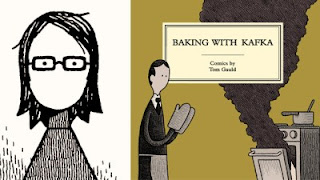
Review: Baking With Kafka by Tom Gauld

https://www.amazon.ca/Baking-Kafka-Tom-Gauld/dp/1770462961/ref=sr_1_1?ie=UTF8&qid=1509805343&sr=8-1&keywords=baking+with+kafkaBaking With Kafka
By Tom Gauld
Drawn & Quarterly
9B781770462960


British cartoonist and illustrator, Tom Gauld is the author of the graphic novels Goliath, Mooncop and You’re All Just Jealous of My Jetpack. Baking with Kafka is his recent collection of short comics, many of which have already been published in The Guardian, New Scientist and The New York Times. Gauld’s drawings are simple, yet perfectly executed, without any superfluous detail. His short strips (1 to 8 panels) are usually funny, but above all, they’re smart and insightful.


The high-brow mention of Kafka in the title might seem ironic to more than a few people, particularly when it’s combined with baking, and the fact that only three strips in the collection relate to the Czech author. The Kafka reference may have to do with Gauld’s reliance on absurdity to get a laugh. Just imagine a comic strip in which two books are lamenting about their adaptations. One book confesses that his book was made into a German TV movie starring David Hasselhoff. Not to be outdone, the other book declares that his adaptation is far worse—the film, the review states, is a masterpiece and surpasses the source material.


The dominant theme throughout Baking with Kafka is books, not just the nerve-racking writing process, or a writer’s doomed attempt at creating something truly original, but also what happens once the book has been written. In one strip, Gauld serves up aptly named authors’ cocktails: the Rejected Manuscript, the Meddling Publisher, the Dreadful Review, and finally, the Disappointing Sales Figures. Gauld also reconstructs classics, adding forgotten chapters to Jane Austen’s Emma and unveiling previously unknown final chapters of Charlie and the Chocolate Factory. There’s also his classic literature with added science: Lady Chatterley’s Lepidopterist, and Sense and Seismology.


Among my favourite strips in this collection are when Gauld combines literary creation with new technology. Consider some of these murder methods for modern mystery writers: run over by a self-driving car, an exploding e-cigarette, strangled with a smartphone charger cable or pushed off a cliff while instagramming. Gauld also delivers a few keyboard shortcuts for novelists that include combinations to find and fill plot holes, remove boring bits, make a protagonist more likeable and add sexual tension. There are also new formats for novels that include a drone book, a holographic information crystal, an odourless glass and a T-shirt.


But Gauld also pokes fun at science, pop culture and the human condition in this collection, bringing to light more than a few uncomfortable truths that will have readers shifting in their seats. In "Revolution!" a rabble-rouser encourages a crowd to smash the system, bring down the government, and march on Parliament demanding change. The crowd, however, wants change but is only willing to sign a petition. "Pass the pen!" Most of us are guilty of signing at least one e-petition on social media for the sake of change. Sadly, there are many more armchair activists than we care to admit.


This collection is one sly, witty, sarcastic comic after another, and the humour is refreshingly British. Brimming with creativity, this book demonstrates how entertaining thinking outside the box can be. The reader might only be cautioned not to read this in public transit, as I did. There are plenty of unexpected laugh-out-loud moments. Minimalist stick men and women may remind us of our elementary school days, but these strips are very much for the thinking adult.


This review has been cross-posted at the Montreal Review of Books.
Read more »
0 com

Adult Onset by Ann-Marie MacDonald

Adult Onset
Ann-Marie MacDonald
Knopf Canada


Ann-Marie MacDonald is an award-winning actor, playwright, broadcaster and author. Given the range and depth of her talents, readers should not be surprised to read something completely original in Adult Onset. Although there are some similarities with her two previous best-selling novels Fall On Your Knees and The Way the Crow Flies, namely a father in the Royal Canadian Air Force and a mother of Lebanese descent, MacDonald’s new release does not span decades.

Instead Adult Onset takes place in real-time, focusing on just 7 days in the life of forty-something stay-at-home mom Mary Rose MacKinnon, also known as Mister. In this typical week, which starts out relatively peacefully, Mary Rose toils alone with her 4-year-old son and willful 2-year-old daughter while her partner is out of town. For unexplained reasons, she is suddenly seized with discomfort and then pain.

As a child, she had a medical condition that she has long since grown out of. The adult onset of her pain, as she slowly discovers, is the resurfacing of long-buried early childhood trauma that she has not yet come to terms with. The reader follows Mister’s every thought, slipping back to her vivid childhood memories, as she tries to pinpoint the source of her malaise.

Raising young children is, after all, when most of us are likely to revisit our childhoods. Mister’s parents, Dunc and Dolly, may not seem ideal by the standards of today’s helicopter parents. They are tough as parents were in the day when it was believed that a coddled child would not fare well. Mister is also a child who was born in Germany, where her father was stationed. Dolly, like many military wives, had to come to grips with the strain of raising her young children far from her family, while grieving the loss of two other children.

I identified very closely with Mister, as I had my two children late in life and was familiar with the obsessive thoughts about banishing BPA-laden plastic containers and finding organic ingredients year round for my children. I was also haunted by the resurgence of my own childhood trauma, which MacDonald portrays perfectly, so perfectly in fact that I was convinced that this book was a memoir.

Rather than using trauma as a literary device to propel the story, the author opted for a realistic, intellectually honest portrayal of trauma, a process of two steps forward one step back, until Mister has her epiphany. There is other trauma in Adult Onset that I found equally as moving. As a young adult, Mister came out to her parents in the early 1980s.

Although straight folk often equate the eighties with sexual openness, Dunc and Dolly are anything but accepting of Mister’s sexual orientation. While it is easy for outsiders to dismiss this as mere bigotry, MacDonald takes us in for a close-up of Mister’s relationship with her parents and shows us where the pain lies, particularly in relation to her father.

He is not horrible or narrow-minded. Instead, he is a warm, intelligent, loving father who just can’t accept his daughter’s homosexuality, which he sees as a lifestyle choice and not a matter of identity. MacDonald does a beautiful job of balancing the story with Dolly and Dunc’s acceptance and rejection of their daughter’s homosexuality, something that afflicts Mister’s entire adult life.

 According to MacDonald, Adult Onset was the most interior of her three novels and the hardest one to write. She describes it as the third book in a trilogy, and while it may appear to be a memoir, the author has said that it is about a character who is very similar to herself, living in a parallel universe.

 I was taken aback by this book for many reasons. As an army brat who grew up in Kingston, Ontario, where many of Mister’s childhood memories are set, MacDonald describes the town exactly as I remember it, right down to her father’s drive to RMC in the morning. In fact, I lived a few streets away from Our Lady of Lourdes, a Catholic grade school in Kingston where a clear-eyed nun identifies Mary Rose MacKinnon as a gifted child.

My personal connection to the book aside, this is a beautiful, spellbinding story. Although some may argue that it doesn’t have quite the same entertainment value as Fall On Your Knees, I would argue that Adult Onset will be one of her most enduring books. Let’s hope that there will be many, many more.

This has been crossposted at Montreal's Rover Arts.
Read more »
0 com

Jimmy Beaulieu's Bikini

Here's a review I wrote for the Summer 2014 issue of the Montreal Review of Books. Because the following graphic novel was pretty slim, I spent some time at the public library reading other works by Jimmy Beaulieu. He definitely dares to be an innovator, and I'm sure that there are people "borrowing" some of his unique ideas. I particularly enjoyed his take on body image, both male and female.  

My Neighbour’s Bikini
Jimmy Beaulieu
Conundrum Press

Jimmy Beaulieu is a creative force in the French-speaking graphic novel milieu. The cartoonist has published 16 books in the past 14 years, in addition to working as the publisher at Mécanique Générale and starting his own small-print press Colosse. In 2010, English Canada was finally able to see some of Beaulieu’s work with the release of Suddenly Something Happened. It was the story of Beaulieu’s life, his childhood growing up among a huge extended family on Île d’Orléans, his parents’ separation, his years of singledom in the Métropole, and finally life with his girlfriend in Montreal’s Rosemont. Suddenly Something Happened showcased Beaulieu’s significant skill as a graphic artist and his wonderful sense of humour. However, it failed to show another aspect of the cartoonist’s considerable talent, something that is fortunately in My Neighbour's Bikini.

Originally published in French in 2006, My Neighbour’s Bikini is the story of two shy neighbours living on the Plateau who meet on a sweltering summer day when everything grinds to a halt because of a power blackout. Simon introduces himself to his neighbour Bernadette on a downtown street, and after they walk home together, Bernadette invites Simon to go for a swim at the neighbourhood pool. The chance meeting has an authentic cringeworthy feel to it, mainly because of the realistic dialogue, and this short tale offers a very accurate depiction of Montreal. However, at first glance, the story has some sizable shortcomings. I initially thought that the problem might be the translation, but upon closer examination I realized that there was a problem with the story’s flow.

In a graphic novel the reader has to be able to readily understand the relationship between two consecutive panels, through visual or textual clues. However, in my first reading of My Neighbour’s Bikini, this relationship between panels was not always clear. Two vignettes have been inserted into the storyline that have zero or little impact on the outcome of the narrative. In the first instance, Bernadette and Simon’s conversation is interrupted by a sequence with a young man cycling on the Mont-Royal. In the second, the story jumps abruptly from Bernadette and Simon walking home to two women in an apartment sharing an intimate moment. One of these women, who the reader later meets at the pool, is Bernadette’s neighbour. While these two vignettes were initially confusing, they do add some atmospheric detail to the story, lending it an overall dreamlike quality. Introducing vignettes into the traditional storyline, I discovered, was a recurring pattern in Beaulieu’s other work. This is especially true in À la faveur de la nuit, a humourous tale about two women telling each other stories late into the night.

Another recurring feature in Jimmy Beaulieu’s work that was non-existent in Suddenly Something Happens is nudity, which is tastefully presented and never gratuitous in My Neighbour’s Bikini. Beaulieu has considerable talent at drawing nudes, and the author should be given credit for presenting natural-looking full-hipped women rather than the standard waif variety. In the past, he has presented work with frontal nudes of men, which was the subject of complaints at the Quai des Bulles Festival in St Malo, France. Naked women were apparently fine, but a naked man in an intimate moment was apparently offensive….

I must admit that I was initially puzzled by the publisher’s choice to translate a book that was first released in French eight years ago. Obviously, it did not reflect how far the author has come since then. But My Neighbour’s Bikini, although not Beaulieu’s best, is tamer than some of his other work, and it may be a way to test the waters to see how English speakers will react to his more audacious content. Overall, once I accepted his non-traditional storyline, I enjoyed the oneiric quality of his work, and of course, I liked that his characters, both male and female, looked like everyday people, a refreshing and welcome change.

Other book-related reviews
Lily and Taylor by Elise Moser
World of Glass by Jocelyne Dubois
The Luminaries by Eleanor Catton
Letting It Go by Miriam Katin
My Mother, the Nazi Midwife and Me by Gina Roitman
Stony River by Tricia Dower
Susceptible by Geneviève Castrée
Studio Saint-Ex by Ania Szado
Bombay Wali and other stories by Veena Gokhale
The Last Runaway by Tracy Chevalier
Gay Dwarves of America by Anne Fleming


Read more »
0 com

The Other Side of Youth by Kelli Deeth

This is one of four reviews that I wrote for the Globe and Mail this year. It was a big step up from being a book blogger, and more than once, I wondered if I was up to the challenge.

Some of you may also know that I am now the Books Editor at Montreal's Rover Arts, an online arts review. This is a volunteer position for a few hours a week to hone my editing skills. I also have a day job. I'm a language professional, which is both demanding and rewarding, yet my blog is still my first love. 

I'd like to thank you, my readers, for your support. I've just completed my fifth year of blogging.

Happy New Year!

The Other Side of Youth, by Kelli Deeth, Arsenal Pulp Press, appearing in the Globe and Mail on November 29.

More than a decade has passed since the release of Kelli Deeth’s critically acclaimed The Girl Without Anyone. Set in a middle-class Toronto suburb, the collectio n of connected stories followed Leah, a young teen of recently divorced parents who are too self-involved to notice their daughter’s need for attention. After dropping out of school, Leah engages in high-risk behaviour, seeking love in all the wrong places. This highly realistic collection showcased Deeth’s ability to write taut, compelling fiction about someone as familiar as the girl at the mall, or the girl next door.

Deeth’s latest collection of short stories, The Other Side of Youth, is far more ambitious and even more intense. Set entirely in and around Toronto, the stories focus on life-changing events, serving up highly plausible yet often unsettling outcomes–the other side of personal issues that often go unseen. The female protagonists in the 11 tales range in age from their early teens to their late thirties. Each struggles with the life-choices she has made and their inherent consequences.

Picking up a theme from The Girl Without Anyone, Deeth writes convincingly about the vagaries of adolescent longing. Using simple prose, the Toronto-based writer delivers powerful narratives that are both alarming and realistic. In “End of Summer,” 13-year-old Sandra, grieving the loss of her brother, is repeatedly drawn to a field where girls are rumoured to be assaulted. In “Correct Caller,” one of several exceptional tales in this collection, 16-year-old Michelle sets out to distance herself from her embittered mother and prove that she can take care of herself. Landing a job over the phone, the 16-year-old is unfortunately hired by exactly the type of man her mother has warned her about, inadvertently putting herself in harm’s way. In “A Boy’s Hand,” adolescent Tanya seeks affection from an unstable boy, even after he is openly hostile towards her.  In the end, he threatens her with his father’s hunting rifle. In the conclusion of this disquieting tale, Deeth brilliantly taps into the traumatized girl’s mind: “…because it was a gun and it was pointed at me, it had gotten inside. Things that were on the inside never got out. They found a place to live, and when you closed your eyes, they showed themselves.”

Many of the exceptional stories in this collection deal with difficult choices related to motherhood. In “The Things They Said,” Courtney is reaching the end of her child-bearing years, and although she and Michael have decided not to have children because of their own dysfunctional childhoods, Courtney still feels that something is not right, regardless of what they tell each other. In “Ari,” Jana is unable to carry a child to term, and her otherwise loving relationship with Peter begins to disintegrate. Peter longs for a daughter like his niece Ari. The centerpiece, however, is the very moving “Vera’s Room.” The narrator and her husband Andrew adopt seven-year-old Vera, a foster child. Despite the couple’s decision, the narrator’s mothering instinct does not kick in. Vera senses this and rebels against her new mother. For the narrator, Vera is not the child she thought they would have. To make matters worse, Andrew is a natural father who reminds his wife that “it’s not all about her.”

The Other Side of Youth
is a series of finely honed short stories, the kind that linger in the mind well after the book is finished. The extremely rich subject-matter and the author’s ability to write satisfying endings could well be the reasons for this. Deeth is a great writer of short fiction, and The Other Side of Youth is the best collection of short stories I have read in recent memory. It was well worth the 12-year wait.

My other reviews in the Globe and Mail.
The Last Runaway by Tracy Chevalier
Bone & Bread by Saleema Nawaz
Studio Saint-Ex by Ania Szado


.
Read more »
0 com

Review of Lily and Taylor by Elise Moser

When the Lily and Taylor meet at a local high school, they discover that they have something in common--both their mothers had been in car crashes. While Taylor's mother died, Lily's mother survived, but the head injuries she sustained often require Lily to act as the parent.

Taylor, too, has lived through more than just the death of her mother. After her mother's death, she goes to live with her older sister and her violent partner. Taylor witnesses the escalation in violence until one day her older sister is killed, forcing Taylor to live with her grandparents in a new town and be a surrogate mother to Mason, her sister's 5-year-old son.

Moving to a new town has an upside for Taylor. It means that she is far away from Devon, her intense and controlling boyfriend. Just as Taylor begins to flourish at her new high school, Devon shows up with a friend and insists on taking Taylor for a ride. Lily hops in at the last minute, and the four of them go for a drive that no one will soon forget.

Lily and Taylor is the raw account of two teenage girls negotiating a far from perfect world. In spite of their traumatic pasts and weighty adult responsibilities, the two strike up a fast and furious friendship--something to sustain them through their difficult moments and add some much needed light to their daily lives.

Author Moser takes plenty of risks with Lily and Taylor, never shying away from the realities and darkness of domestic violence. While this is fine fiction, it also provides an eerily accurate depiction of an abusive relationship as it ebbs and flows. This was an intense read, one that I could not put down. 

Lily and Taylor is considered a Young Adult (YA) book, but people of all ages will find some food for thought in this compelling Thelma and Louise-style adventure.

This review has been cross-posted at Rover Arts.


Other reviews
World of Glass by Jocelyne Dubois
5 Broken Cameras by Emad Burnat and Guy Davidi
Detropia by Heidi Ewing and Rachel Grady
Finding Dawn by Christine Welch
The Fruit Hunters by Yung Chang

.


Read more »
0 com

World of Glass by Jocelyne Dubois

Louise Bourgeois's Araignée
World of Glass
Jocelyne Dubois
Quattro Books

World of Glass has recently been nominated for the Paragraphe Hugh MacLennan Award for Fiction.

Leaving la Ville Reine behind and her partner who has moved on, 30-year-old Chloé returns to her Québécois roots, landing a job at a fashion magazine selling ad space to high-end Montreal boutiques. This is a fresh start. She finds new love and explores la métropole, a city of dizzying possibilities. But there are indeed stresses, a lot to get used to. There is temptation and plenty of heady stimuli competing for attention. The reader, too, will experience this adrenaline and inability to focus through Dubois’ brilliant use of adjectives, once considered a no-no in fiction writing.

When a love interest sours, just as the twin towers crumble, Chloé falls into a fragile, rudderless realm, and the reader experiences the highly unsettling world of mental illness. Chloé’s return is a stiff climb, but she refuses to let her illness rule her life. She lives as openly and honestly as she did before, rediscovering love and creativity, with a realistic misstep along the way.

Bipolar disorder, formerly known as manic depression, is used too freely as a synonym for mood swings these days. World of Glass serves up the real thing, while successfully side-stepping the pill-popping shut-in narrative we all imagine. This novella gives a much-needed look at bipolar disorder and offers an accurate depiction of Montreal. Love can indeed be found at Toi, Moi & Café.

At only 93 pages, World of Glass offers an intense few hours of reading. It's a little like going to a restaurant for dinner, but only ordering what you really want--dessert.

Other related posts
Summer Reads: Letting It Go by Miriam Katin
My Mother, the Nazi Midwife and Me by Gina Roitman
Stony River by Tricia Dower
Susceptible by Geneviève Castrée
Studio Saint-Ex by Ania Szado
Bombay Wali and other stories by Veena Gokhale
The Last Runaway by Tracy Chevalier
Gay Dwarves of America by Anne Fleming


. 
Read more »
0 com

It's All Science Fiction

Science Fiction
Joe Ollmann
Conundrum Press

On the heels of Joe Ollmann’s widely acclaimed Mid-life comes Science Fiction, the story of Mark Sett, a high school biology teacher who experiences an unforeseen crisis that shatters his belief system and threatens his long-term relationship. But it isn’t his unexpected breakdown that alienates his live-in girlfriend Sue, an over-educated grocery store clerk; instead, it’s what triggers his revelation and his wild claims that she finds so bewildering.

Mark, “a pragmatic and rarely frivolous man,” is concerned strictly with the facts and evidenced-based truths, so when he selects Taken At Night, a movie on the straight-to-the-video express, his girlfriend is perplexed. Not only is it science fiction, something her partner has always loathed, but it’s over-the-top cheesy. As Sue and Mark watch the opening scenes of the film, Mark begins to weep and later confesses that the film triggered a long-repressed memory of being abducted, not by gangsters or masked men, but by aliens….

Sue’s understandable response to her partner’s bombshell disclosure is shock, which quickly turns to annoyance. After all, asking your partner to believe a claim that is so dramatically out of character is an excessive demand. A bout of depression or even a repressed memory of sexual assault would indeed have been easier to accept. While Sue’s reluctance to take such a leap in faith is understandable, most readers will find themselves looking for some way to believe Mark and not dismiss him as delusional.

Ollmann’s work is always replete with humour, and Science Fiction is no exception. While there could have been a more plausible cause for Mark’s crisis that was equally at odds with his scientific way of thinking, such as a sudden belief in God or creationism, it probably wouldn’t have been as funny. In spite of the outrageousness of Mark’s apparent abduction, the turmoil the couple experiences in the aftermath of his revelation is highly realistic, with Ollmann skillfully and accurately capturing the various stages of the couple’s demise.

Science Fiction is a page-turner in no small part because of the strong characters Ollmann has created and his mastery of the story’s pacing. In addition, the author has a great ear for dialogue, which is infused with a wonderful wry wit. His frames also show a wide range of emotion demonstrating his keen sense of observation, but for the sake of variety, he could have experimented a little more with the layout instead of repeatedly giving us the same nine-frame panel. In the end, Science Fiction was enjoyable, but it was not quite as entertaining as Mid-life, for the simple reason that it is easier to relate to a 40-year-old man revisiting fatherhood than a high school teacher who believes that he was once abducted by aliens.

But these are minor points. Ollmann is nevertheless a gifted storyteller.

This has been cross-posted at the mRb.


Other related posts:
Review of Mid-Life by Joe Ollmann
AYA by Abouet and Oubrerie
Paul Goes Fishing by Michel Rabagliati
Susceptible by Geneviève Castrée


.
Read more »
1 com

Summer Reads: Stony River by Tricia Dower

Stony River
By Tricia Dower
Penguin Canada

Often portrayed as the era of innocence, the 1950s brought North Americans post-war prosperity, suburban life and the nuclear family, with its clearly defined gender roles. The medium of the day—television—served up squeaky clean characters like June Cleaver, the mother and wife on television’s Leave It To Beaver, a role model to legions of housewives. But as most viewers were aware, made-for-television families had little in common with those living in small towns like Stony River, the setting and title of Tricia Dower’s novel.

In the Author’s Note, Dower describes the 1950s as repressive “when secrets crouched behind closed doors.” In her novel, she shows what goes on behind those doors and unveils the dangers for all young women who came of age in the mid-twentieth century. Based on the actual
killing of a police officer while Dower was in high school and the murderer’s subsequent crimes, the story sheds light on not only the era’s glaring gender inequalities but also the town’s sordid underbelly that is worthy of a film noir.

I love this cover.
Teenaged neighbours Linda Wise and Tereza Dobra spend their time hanging out in the summer smoking “punks” or cattails on the polluted river’s shore. The blond, Linda Wise, comes from a middle-class family and spends her time with the darker-complexioned Tereza, whose household is violent and decidedly working-class. Nevertheless, it is Tereza who snubs Linda for her inexperience.

One hot June day, the two girls are shocked to see a pale teen girl accompanied by police officers
emerge from the home of Crazy Haggerty, the town oddball. Everyone had assumed that Haggerty lived alone. Crazy Haggerty’s relationship to the mysterious shut-in teen, Miranda, is discussed in hushed tones.

Linda, Tereza and Miranda cross paths several years later in connection with a series of heinous sex crimes. But this happens after freewheeling Tereza runs away and play-it-safe Linda slips up. Miranda, however, proves to be exceptionally bright and has special skills, in spite of never completely overcoming her years of isolation.

“Nothing was as it seemed back then,” writes Dower in the Author’s Note, and fleshing out what lurks beneath outward appearances is what Dower does best in Stony River. She’s also adept at creating full, plausible characters. My favourite is the deliciously foul-mouthed, sexually promiscuous Tereza Dobra. Fiction is in dire need of a few good bad girls with agency to shake up those preconceived notions of the 1950s.

There’s also a wonderful infusion of Celtic lore alongside some beautiful writing in Stony River. Dower writes, “James said that if words could be held and tasted and smelled they might be enough to live on.” There is, however, one shortcoming. There are two stories that don’t come together convincingly enough at the end. In fact, I could easily see two solid standalone novels—the Crazy Haggerty and Miranda story and that of Tereza and Linda. The author has taken a step back and incorporated both stories under the broader theme of the town—Stony River.

The theme of rape is central to this tale, and it’s interesting to see just how little we have advanced in 50 years. At trial, the rape victim in this story is made to feel that she isn’t telling the truth, and her credibility is further undermined because of the weight she put on in the aftermath of her assault. After all, no one would ostensibly rape an overweight woman…. Similarly, this week in the news it was reported that one in five Canadians between the ages of 18 and 34 believe that “women are responsible for sexual assault because of their actions or appearance,” according to Anu Dugal, Director of Violence Prevention at the Canadian Women’s Foundation.

If you’re interested in reading a well-written novel reminiscent in parts of a true crime story, Stony River is worth your while. You may even want to read it after perusing the highly realistic photos of the 1950s photo journalist Weegee (Arthur Fellig) or while listening to a little Patsy Cline.

This review has been cross-posted at Rover Arts.


Other reviews of books you might like:
Susceptible by Geneviève Castrée
Studio Saint-Ex by Ania Szado
Bombay Wali and other stories by Veena Gokhale
The Last Runaway by Tracy Chevalier
Gay Dwarves of America by Anne Fleming
One Good Hustle by Billie Livingston
The World is Moving Around Me by Dany Laferrière
The Return by Dany Laferrière
The Goodtime Girl by Tess Fragoulis

.


Read more »
1 com

My Mother, the Nazi Midwife and Me by Gina Roitman

Gina Roitman: Photo by Lynn Hatwin
We've all heard stories from our mothers, stories that made us feel uncomfortable or that we rolled our eyes at. As young girls, the tales were often too far removed from our own experiences to have any meaning.

It's usually much later in life when these stories carry much more significance for us. These stories tell us who we are and add a few more missing pieces to our own identity puzzle.

Writer Gina Roitman has just released a chilling documentary featuring some incredible personal discoveries. She has spent the last eight years filming her investigation into a tale that her mother began telling her when she was very young.

Gina Roitman grew up in Montreal, but was born in Germany in the years following the Second World War. Her parents were Holocaust survivors whose family members had all perished in concentration camps. Roitman's mother often told her young daughter stories of the atrocities of Nazi Germany. But young Gina was living in a different country at a different time, and as can be expected, she wasn't all that interested in her mother's stories. She also refused to believe that all Germans could be as horrible as her mother said, something that infuriated her mother.

Around the world, many people believe that after World War II ended, the Nazis suddenly disappeared. But as we see in the documentary, this was not the case.

Roitman's parents met at an overpopulated Displaced Persons camp outside Passau, Germany, in the US military zone. When Roitman's mother became pregnant, she insisted that her daughter be born at a birthing centre, and not in the camp. Too many Jewish babies were inexplicably dying there; a murderer was ostensibly afoot. The mother said that she had saved Gina's life.

For Roitman, this was just one of her mother's paranoid stories. Then, many years after her mother had died, Roitman discovered the work of Anna Rosmus, a German historian who had investigated the treatment of Jews in Passau in the 20th century. It was then that Roitman heard the story again of the mysterious deaths of Jewish babies at the Displaced Persons camp at Pocking-Waldstadt where her parents had lived.

In My Mother, the Nazi Midwife and Me, a one-hour documentary, Gina Roitman returns to Passau for the first time in her life to meet Anna Rosmus, investigate her mother's claims and ultimately discover some important parts of her own identity. This is a moving documentary that should not be missed. The footage and stories are haunting.

To see a trailer of the film click here.

My Mother, the Nazi Midwife and Me will be showing on Saturday, May 18 on the CBC Documentary Channel. 

Other documentaries:
5 Broken Cameras by Emad Burnat and Guy Davidi
Detropia by Heidi Ewing and Rachel Grady
Finding Dawn by Christine Welch
The Fruit Hunters by Yung Chang


.
Read more »
2 com

Susceptible by Geneviève Castrée

Susceptible 
Geneviève Castrée
Drawn and Quarterly

Susceptible is Geneviève Castrée’s first full-length English-language graphic novel. The multi-disciplinary artist and Quebec native has crafted a moving tale about Goglu, a bright, dreamy little girl who has a less than ideal start in life. As the title implies, she is sensitive, but Vulnerable would have also been a fitting title.

The reader meets Goglu still in the womb asking about whether sadness can be inherited from one generation to the next. The little girl is born to a 19-year-old Quebec mother and her English-speaking logger boyfriend in 1981. Her father played a very minor parenting role before moving to British Columbia, “a mythical kingdom where dads go to disappear.”

Her mother like droves of other young people in the early eighties had gone out west to make some quick money during the Alberta oil boom and experience her first adult adventure. Her mother, Amère, which aptly reflects her bitterness, returns to Quebec alone to give birth, but family support is not forthcoming. The youngest of 16 children, Amère didn’t receive much herself in the way of parenting.

Goglu is a latch-key kid from the time she starts school. Her mother sets an alarm clock so that the six-year-old knows when it is time to get ready and catch the bus to school.

Amère is a struggling single mother who still parties like most 20-year-olds, but strictly on the weekends. She eventually meets her significant other, Amer, and they move in together, but Amer in no way assumes any fathering responsibilities, and he resents Goglu. The weekend parties continue, and too ashamed to invite friends over to her house, the girl finds herself alone, a lot. As a teen, Goglu is troubled by her mother’s increasing dependence on alcohol.

At her South Shore school, Goglu is an outcast, an odd duck among a bunch of suburban kids. But in high school, she makes friends through that great equalizer—drugs. She struggles to finish high school as she starts to use harder drugs, and then eerily finds herself in her mother’s previous predicament, the one that ruined “her bright future.”

Geneviève Castrée shows genuine talent as a graphic novelist and has created a compelling story. Particularly innovative is the circular panel she uses to illustrate an intense argument with her mother. We can all attest that arguments tend to be circular in nature, often returning to the original accusations.

Of all the books I’ve read in the last few years, I found Susceptible the most heart-wrenching. Goglu, like many unwanted children, internalizes her mother and stepfather’s resentment, which unsurprisingly results in her own anger, depression and self-imposed alienation.

Although it would be easy to point the finger at Amère for being a poor mother, she too was an unwanted child. As a single-parent with few resources, she chose to live with another wage-earner to make life and decision-making a little easier. In her desperation, she not only chose a man she didn’t love, but also one who had little patience for her daughter.

A lot of people will find this a harrowing read, but for many this will be validation for their own experiences growing up in cash-strapped homes with ill-equipped parents. Susceptible should be on the bookshelf of every teacher, guidance counsellor, social worker and planned parenthood advocate.

I applaud the publisher for taking this risk on a story that could potentially help a lot of people, both young and old.

This has been cross-posted at Rover Arts.

Other reviews
Studio Saint-Ex by Ania Szado
Bombay Wali and other stories by Veena Gokhale
The Last Runaway by Tracy Chevalier
Gay Dwarves of America by Anne Fleming
One Good Hustle by Billie Livingston
The World is Moving Around Me by Dany Laferrière
The Return by Dany Laferrière
The Goodtime Girl by Tess Fragoulis

Read more »
0 com

Studio Saint-Ex by Ania Szado

The gift of a book can change the course of a child’s life,” writes Ania Szado in the acknowledgments of her recent historical novel Studio Saint-Ex. Szado is referring to The Little Prince by Antoine de Saint-Exupéry, which she received as a gift at age 11. This is when the seed of Studio Saint-Ex ostensibly was planted.

Ania Szado has researched the life of Antoine de Saint-Exupéry while he was writing The Little Prince in 1943 and has created his character and that of his estranged wife, Consuelo, based on widely known historical facts.

The Saint-Exupérys are in essence insta-characters, torn from the pages of history. Studio Saint-Ex is a fictionalization of their lives when they were living in New York as expats during the Nazi occupation of France.

Into the storyline, Szado has inserted her own original character, 22-year-old Mignonne Lachapelle, an ambitious young fashion designer, who meets Antoine de Saint-Exupéry through the French community. As can be expected, the young woman falls in love with the legendary writer.

As history would have it, the couple had an open marriage, and this serves as Mignonne Lachapelle’s promising point of entry into their lives. At the same time, the ingenue is trying to forge a name for herself in the fashion industry, just as there is an upsurge in demand for high-fashion items in New York.

In her first job as a designer’s assistant, Mignonne is ordered to drum up business in the French community, where fashion trends are started. As the wife of an exalted figure among expats, Consuelo is considered influential and, consequently, a highly prized potential client. While Mignonne proposes items from her clothing line to Consuelo, she is also trying to seduce her husband. The wife is wise to this and plays along, continually turning the situation to her own advantage.

Although initially the story has great narrative force, it quickly loses momentum and becomes predictable. What saves the book is some particularly inspired writing by Ania Szado on the art of garment design.

As tempting as it may be to use historical figures as the basis of a novel, history still imposes some rather severe limitations, particularly on this storyline. Szado states in the book’s Afterword that some sources suggest that Saint-Exupéry’s extramarital relationships were “exclusively platonic.”

Consequently, the love triangle serves as little more than a tease to readers, reducing the focus of the novel to the aspirations of the young fashion designer. In the end, the story becomes completely implausible when Mignonne manages to co-opt Saint-Exupéry’s work and catapult her own career.

Studio Saint-Ex is a forced fit. Ultimately, Saint-Exupery’s name and The Little Prince, among the best-selling books of all time, are used to draw in readers, but the story is too farfetched and contrived to take seriously.

This has been cross-posted at the Globe and Mail.


Other reviews
Bombay Wali and other stories by Veena Gokhale
The Last Runaway by Tracy Chevalier
Gay Dwarves of America by Anne Fleming
One Good Hustle by Billie Livingston
The World is Moving Around Me by Dany Laferrière
The Return by Dany Laferrière
The Goodtime Girl by Tess Fragoulis

 .

Read more »
0 com

Bombay Wali and other stories

Bombay Wali and other stories
Veena Gokhale

A former Bombay journalist, Veena Gokhale has penned her first collection of 12 short stories set almost entirely in India. While her stories set in Bombay will impart a genuine taste and flavour of India familiar to Indophiles, there is a definite departure from traditional India in this collection, giving a sense that change is in the air. The author throws in a few surprises, such as a story set in Japan in the last third of the book, serving as a type of aesthetic contrast, in addition to a tale about a young Canadian woman who finds moving spiritual enlightenment in Kathmandu. For anyone who loves stories about the Indian subcontinent, this collection offers some gems that are both evocative and visually pleasing.

The title story, “Bombay Wali,” also the collection’s longest, brings together a number of young professional women eking out an existence in Bombay. Renuka’s dreams are shattered when she has her bag slashed and money stolen outside a bank. Too ashamed to tell her father, she entertains the idea of robbing a bank, a plan suggested by her friend Gulnar on a girls’ night out. In desperation, Renuka agrees to take part. For their disguise, six burqas are purchased, and then the plans abruptly change. This leads to a less than satisfying ending to an otherwise original and engrossing tale. “Bombay Wali” is a welcome shift from the traditional portrayal of Indian women.

Equally audacious is “the Room,” which opens with a young couple, Suj and Vikram, smoking an illicit substance. As their relationship becomes more intimate, Suj resists the pressure to take a key for a room from Vikram’s unsavoury friend so that the couple might be alone. Although Suj is portrayed as more sexually open than her friends, as the reader witnesses, the stakes are still high for even the most minor displays of public affection.

My favourite in the collection is “Zindagi Itefaq Hai” (Life is Chance). Vishwanath Iyer is an investigative journalist at The Disquieter, a small-time Bombay rag. As fate would have it, page two of his report, which contains a key quote, is blown out the window and into the alleyway. Unable to retrieve his page two, Vish rushes to the station where his source, a judge, is catching a train. Both humorous and realistic, this story is easy to visualize, “The station was a tide of bodies, a cacophony of sounds – human and mechanical, a solid flow of heat-resistant energy. Nevertheless, the announcer’s steady voice, talking alternatively in Marathi, Hindi and English, managed to prevail over the chaos.” In spite of its somewhat weak ending, “Zindagi Itefaq Hai” feels like the beginning of a very entertaining full-length novel.

Other noteworthy stories include “the Tea Drinker” about an adolescent boy who befriends a rich social outcast and “Freire Stopped in Bombay,” which details the ravages of hunger on a poor student who is too proud to borrow money. In addition, despite its pedestrian title, “Middle Age Jazz and Blues” is the most beautiful story in the collection. At a jazz concert, middle-aged single Feroza is struck by the vision of the love of her life, who died tragically.

As is usually the case, some stories are not as interesting as others. However, in spite of some vague references to “things” and “stuff,” a handful of heavy adverbs and some unconventional dialogue tags, Veena Gokhale shows genuine promise as a short story writer and future novelist. Let’s hope she chooses to write more about the Bombay newspaper world.


This has been cross-posted at Rover Arts.


Other reviews


One Good Hustle by Billie Livingston
The World is Moving Around Me by Dany Laferrière
The Return by Dany Laferrière
5 Broken Cameras by Emad Burnat and Guy Davidi
Detropia by Heidi Ewing and Rachel Grady
The Goodtime Girl by Tess Fragoulis


.


Read more »
0 com

Gay Dwarves of America by Anne Fleming

There are a lot of great writers in Canada, yet there seems to be little meritocracy. While some great writers are widely promoted, others rarely get the attention they deserve. This is the case of the inventive, unique and moving Gay Dwarves of America (GDA) by Anne Fleming.

True, it could be that GDA is a collection of short stories, not always the first thing people reach for when they read. Or, as the title suggests, some of the stories are unconventional, even outlandish, maybe not exactly what everyone might be in the mood for. Nevertheless, the reader will be generously rewarded with this refreshingly original collection of short stories. Fleming strikes that fine balance between humour and realism, reeling us in with a few laughs only to show us a more serious issue we might never have considered.

The nine-story collection contains a wide variety of tales, from the stellar and almost mainstream "Thorn-blossoms" about an eccentric hockey mom who must contend with her once ambitious journalist mother now stricken with Alzheimer's, to the experimental and self-explanatory, "Thirty-One One Word Stories."

In the middle of the spectrum, there are stories about a boy on a unicycle, a bearded parasitologist named Edna and a musical about a bunch of wannabe artists working in inventory at the back of an outdoor equipment store. This story includes a chorus of cashiers and of course (?), a love triangle with the cuckold in a coma.Yes, this is a laugh-out-loud book, but it also elicits a range of other emotions.

The title story, "Gay Dwarves of America," is about two college roommates who, on a whim, set up a chat room for gay men with dwarfism. However, when one of the roommates receives a serious email from a mother who suspects that her son, a little person, is gay, a distance develops between the two friends.

My favourite, "Puke Diary" is about the funny and harrowing events surrounding each family member's experience with vomiting. This even includes an entry on Sarah, the family cat. My least favourite was the "Backstock: the Musical." Although original, I found it long and had to restart it a few times.

GDA is not a quick read and is best enjoyed over an extended period of time, and preferably not on your commute to work. The conspicuous lime green jacket attracted quite a few smiles and inquisitive looks on the metro. Or was it my giggling?

Anne Fleming's stories have been widely published in literary journals, and she has been shortlisted for both the Governor General's Award for Fiction and the Danuta Gleed Award. That said, although GDA might not be considered mainstream fiction, I'm still surprised that it didn't generate more buzz. Fleming is an original talent that shouldn't be missed.

This review has been cross-posted at Rover Arts.


Other book reviews:
One Good Hustle by Billie Livingston
The World is Moving Around Me by Dany Laferrière
The Return by Dany Laferrière
The Goodtime Girl by Tess Fragoulis


.


Read more »