1 com

M60: Faux Pas

The Indoor Pool at Hearst Castle
Yes, there were many a faux pas this year on the world stage. But "faux pas" was also the theme of this year's M60, Montreal's 60-second film festival, now in its fifth year. The M60 kicked off this year's edition at the Casa del Popolo on July 19. Eighty-five filmmakers and their teams got in line to register. Participants could use either the French or English definition of faux pas when creating their films, which had to be submitted one month later on August 19. I was in the crowd that included both Oscar-winning filmmakers and complete newbies, and I left wondering if my filmmaking team (my family) hadn't bitten off more than it could chew. After all, we were going to California for three weeks and would be there when the film had to be submitted.

Nitt Witt Ridge, a California landmark
My husband and I thought that we would find the perfect story at the Hearst Castle. William Randolf Hearst certainly had his fair share of blunders, as did his girlfriend, actress Marion Davies. Maybe we could throw something in about Citizen Kane....No, that would be far too ambitious.

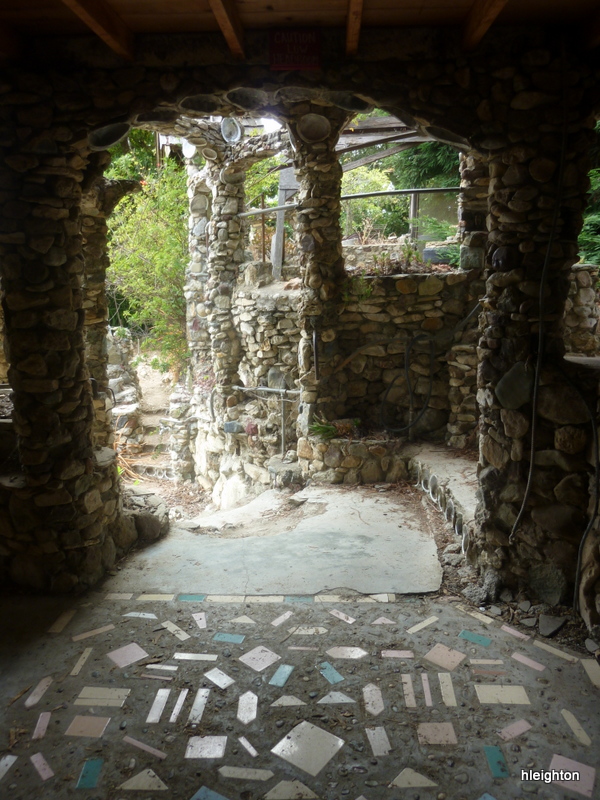
We arrived at Hearst Castle on August 12 and shot extensive film, but struggled to come up with a decent story, or, ah, even a semblance of one. Then we travelled down the road a few miles to Nitt Witt Ridge, a three-storey house made entirely from recycled items and pilfered materials from Hearst's many renovations. The "architect" was Art Harold Beal, the town garbage man, sometime construction worker and village oddball. But damn...we still couldn't see a story. At this point, five days before the deadline, I made an executive decision: we could not get stressed out about the 60-second film festival. We were after all on vacation. My husband agreed. We decided to drop the idea altogether.

Then miraculously an idea presented itself on August 18, as we were hiking between Muir Beach and Pirate's Cove on a steep Pacific Coast trail in Marin County. We found a bouquet of dried roses sitting on a handwritten note when we arrived at the top. It looked almost like flowers to commemorate someone who had fallen from the precipice.... Bingo! We had our very simple story and a beautiful setting with plenty of fog and a weathered guardrail on the verge of collapse. Misstep would be our title.

View from the Precipice
Our first shot is of the bouquet of flowers and the note with plenty of audible wind. Then we cut to a 10-year-old girl who asks her mother if she can move closer to the edge to get a better look. The mother is busy taking pictures and says, "Yes, but be careful." In the next shot, in what is presumably minutes later, the 5-year-old son asks his mother where his sister is.  As expected, the mother rushes over to the guardrail. Then in the last scene, the daughter reappears and asks her brother, "Where's Mom?" That was our stunning twist. The Mom had gone over the cliff.

The Making Of
We shot and edited the entire one minute of film on my husband's iPad and submitted it seconds before the deadline. Just a short note to anyone who wants to try this: we encountered a few problems with the iPad sound editing software. Be prepared....

At the M60 film festival screening we attended, the last scene of our film elicited a gasp from the couple sitting next to us and that was the best feedback we could have possibly asked for.

The M60 was hugely successful this year, selling out all three of its September screening dates, and there were some excellent films. If you are at all interested in making a film or just want to try your film editing software then this is a golden opportunity. And the best part is that the M60 is free for filmmakers.

Related posts:
LA's Million Dollar Theater
Disney Theatre W/ the Kids
Unexpected Beauty of Historic Los Angeles
Park X: the Punjab Palace Reopens
Circus: Sequence 8 at TOHU
Pots and Pans Protests of Bill 78
Felines: Friend or Foe?
Villeray's Subtle Rawesomeness


.


.


Read more »
0 com

Café Vito: Villeray's Espresso Drive Thru

Service window at Café Vito
I took advantage of the early sunny autumn day to go for a walk on Villeray. I stopped in for a latté at Café Vito, a fairly new edition to the Villeray landscape. As I walked through the door of this café, which also doubles as a laundromat, I was greeted by the familiar face of Vito Azzue. He served many a latté and espresso at Café Olimpico on St. Viateur in the Mile End. I spoke to him briefly about his new digs before taking my latté to a tiny table outside, just as two of Montreal's finest in their dress blues walked in and ordered.

In addition to the usual Italian coffee fare, Vito and his sons serve gelato and sandwiches at 151 Villeray, at the corner of Casgrain. The inside is quite small, but it appears that most patrons order from the side window. "I got the idea for a service window when I was in Italy a few years ago," said Vito. As I sipped my latté and enjoyed the sun, I saw a man pull up to the curb in a silver Mercedes, order his espresso from the sidewalk, pay as he stepped up to the counter, down his beverage on the spot, then wave to Vito, say "Well worth the stop," and then hop back into his car. Seconds later, the Mercedes was replaced by a white pick-up truck with another thirsty patron who was also in a hurry.

The wide sidewalks of Villeray make it an ideal place for outdoor cafés, but for the time being zoning is strictly residential, and the borough apparently has no plans to allow for such extensive commercial ventures. For now, Vito is only permitted to have a few tables pushed next to the building.

Café Vito is well worth your stop if you're looking for that perfect latté, but don't feel like going inside anywhere. You can also bring your dog, as the owner has set up two stainless steel water dishes for canine patrons. If you want to try some great gelato, Vito's lemon is divine.

Other posts about Villeray
Pots and Pans Protest of Bill 78
Felines: Friend or Foe?
Food: Villeray's Subtle Rawsomeness
Buying Local: Slak on Villeray


Read more »
0 com

LACMA: Moms Need Fun Too!

Yellow Plastic Spaghetti Art Installation at LACMA
As the mother of a 5- and 9-year-old, there comes a time on a vacation when you have to do something of interest to mum. Yes, a mother must choose something with at least one kid activity, but she needs some spiritually enlightening activity to sustain her through hours of watching the Gator Boys and Sponge Bob and of course, the pool, the pool, the pool. Even if it was in the coolest location. From the LA Westin Bonaventure glass elevator 18-floors up, the pool looked like it was located right at the intersection of South Figueroa and Fifth Streets.


LACMA Kids' Museum
The Los Angeles County Museum of Art (LACMA) and the Getty museum were the two destinations I had in mind, but I chose the former because I already knew how to get there. As you can see, there was a yellow plastic spaghetti art installation that doubled as a playground for the kids, a big hit, and there was a kid's museum where young artists could paint and exhibit their work. From the children's museum, we started with Korean art next door. I told my children to select what they liked best and to show it to me. That worked well, and I was surprised when the Dude chose a hand-painted ceramic dish as his favourite piece, but that was the end of his interest in the museum. He'd already endured 45 minutes of museum stuff, which also included a brownie at the cafeteria.

I'd heard nothing of LACMA until I read Jane Fitch's White Oleander. In fact, the museum is where teenage Astrid has her LSD-induced epiphany about her narcissistic mother. I also  remembered reading that admission was free on the second Tuesday of the month. But when we signed our children up for memberships, we were magically given free admission anyway. Just as an aside, I was expecting Los Angeles to be just as expensive as New York and Paris for eating in restaurants and admission tickets, but this was not the case. With the exception of Universal Studios and Disneyland, I found prices in LA reasonable overall. In fact, there are quite a few free activities in LA.

In the end, I was able to spend 90 minutes at the museum. I walked around with my nine-year-old and tried to show her the fabulous Motherwells, Monets and of course, Picassos. But she just sighed and said, "Not another crooked face." This was right about when I heard a child (yes, mine) throw a temper tantrum in the next room, which abruptly ended as the elevator doors closed and my husband took him down to the entrance to wait for us. I enjoyed my whirlwind visit to the museum and foolishly entertained thoughts of visiting the Getty on our last day in LA. This would not transpire we discovered, as visiting LA involves a lot of driving, and you have to take advantage of every window of opportunity.

View of the Hollywood hills from the Griffith
Just as we were pulling out of the parking lot, our iPad GPS indicated that we were not far from the Griffith Observatory perched atop the hills. The art deco-inspired observatory was a big hit with my son because there were telescopes and plenty of planetary models with  buttons to push, and it was a beautiful drive to the top. We also had a great view of the Hollywood sign on a neighbouring hill, but most of all it felt great to get out of the city just for a few minutes and see it from afar.

The Griffith Observatory is a great family activity, and it's absolutely free.


Other posts about visiting California
LA's Million Dollar Theater
Disney Theatre W/ the Kids
Unexpected Beauty of Historic Los Angeles


Read more »
0 com

LA's Million Dollar Theater

Vendor Just Blocks Away From LA's Financial District
The next day I purchased tickets for Universal Studios with the LA Westin Bonaventure concierge. I mentioned that I had crossed Broadway Street and how impressed I had been with the architecture of all the old theaters. The hotel concierge, Lupe Pitone, told me that it was a beautiful area and assured me that there was nothing to fear during the day. In particular, she mentioned the Million Dollar Theater on Broadway and spoke of its sumptuous interior and thick velvet curtains. She said that as a little girl, she used to wait in a line that snaked around the block to see a double feature on the weekends. "I have some wonderful childhood memories of the Million Dollar Theater," said the concierge.

I went back up to our room with our Universal Studios tickets and information that my husband should not take the subway to LAX at night to pick up our rental car, advice that he fortunately heeded. He said that taking the subway through South Central Los Angeles reminded him of riding the RER through the northern and eastern suburbs of Paris where there are endless low-rent highrise apartments and seemingly nothing else. He also said that there were a few unpredictable commuters who exhibited signs of questionable sanity.

Entrance to the Million Dollar Theater
Back in our hotel room, enthusiastic suggestions of outings elicited crossed-arms and shrugs. My bumps on a log didn't even want to step outside for lunch. I sat back and read another of our California guides and learned about the highly rated Grand Central Market, which happened to be next to the Million Dollar Theater the concierge had talked about. I also read online about Bringing Back Broadway, an LA initiative to restore "the largest historic theater district west of the Mississippi." I just had to take another look, so I offered to go out and pick up some lunch for everyone and told them that I would be back in 45 minutes to an hour.

I walked as quickly as I could down Fifth Street to Broadway, but as the people and scenery changed I felt a knot in the pit of my stomach--yes, apprehension. It had been over 12 years since I had traveled anywhere alone, and as I looked north down Broadway, I thought of the many places I had to forego in Latin America because of this very feeling. There were two tall dirty men dancing erratically on the sidewalk about 10 feet away, and even the hipsters in this part of town suddenly appeared grimy and tough. It would be hard to explain to my husband that on a quick trip to buy band aids and tacos, I got roughed up on Broadway, blocks away from our hotel. I decided against walking anywhere further north and headed south where there were fewer people on the sidewalk.

China Café at Grand Central Market
Along the way I was greeted in Spanish by shopkeepers selling gold, t-shirts, magazines and sunglasses. Then I saw the ornate Million Dollar Theater. Its name apparently comes from the fact that it cost a million dollars to build in 1917. Unfortunately, I was only able to take pictures of the outside because it was the site of a film shoot. The Grand Central Market, which has been in operation since 1917, was also a wonderful surprise, something I never would have expected to see in Downtown LA for many reasons. For one, it was colourful, cheery, and devoid of Armani suits. Two, it was extremely cheap. I bought two chicken tacos for $2.50 each, heavenly shrimp ceviche for $4.00, and a small basket of strawberries, a bag of cherries and a red pepper from a vegetable vendor for just $2.50.

When I got back an hour later with lunch, I showed my husband my pictures, and he was instantly jealous. "I wish I had gone too," he said.

Of all the things we would see in California, historic Downtown LA was the biggest surprise. The "birthplace of vaudeville and cinematic entertainment" did not figure in any of our guide books, nor had I ever seen pictures or heard of these nine blocks on Broadway housing 12 historic theaters. When we think of LA, we rarely think of history, and we really should.

I highly recommend this area. Just dress down and go with someone else during the day. If you go a few years from now, these precautions might not be necessary. Something tells me that Broadway might be completely transformed in the near future.


For further reading on historic LA
Pictures and history of the 12 theaters (A must-see)
Million Dollar Theater

Other posts about LA
Disney Theatre W/ the Kids
Unexpected Beauty of Historic Los Angeles


Read more »
0 com

The Unexpected Beauty of Historic Los Angeles
View Heading Up 4th Street to Flower
As the tour conductor of our family trip, I'd consulted my guide books and Urbanspoon, a great online resource for restaurants, for a spot to eat dinner. Blossom, a family friendly Vietnamese restaurant, had been recommended by both Le guide du routard and Urbanspoon, so I figured it was worth a try.

We had to venture down 5th Street, past Pershing Square, which I'd read was to be avoided at night, and walk two streets below Broadway. At the Square just behind the famous Biltmore Hotel, the scenery and people changed dramatically, from Lexus-driving Armani-clad businessmen to a few urban hipsters, some rubbies, drug addicts and droves of everyday people, walking and socializing on the sidewalks. The language in storefront windows had also  changed to Spanish. The gleaming glass of the skyscrapers had given way to older art deco buildings. Then at the corner of Broadway and 5th Street, I was awestruck. Broadway was lined with old rundown albeit beautiful theatres.

Some of the wonderful embellishment in historic LA
At the corner, I looked at my husband, who seemed wary. Yes, I could smell the urine too, the telltale sign of a densely populated area. As we crossed the street I said, "I wanted to take a picture, but I felt conspicuous." He looked straight ahead and asked, "How much further is it?" Our five-year-old, aka "the Dude," was getting testy. Children had changed how we viewed a city, making us hyper-vigilant about safety.

Our Way Back on Fourth Street


Turning back for a picture was out of the question, but I thought about Broadway through the entire meal, which was pretty good for the price. Unfortunately, with all the Vietnamese restaurants in Montreal, including our favourite on St. Hubert, we have a good reference for comparison. While Blossom had awesome iced green tea and delicious iced coffee served with condensed milk, the chicken curry was too savory for my liking. Yes, I've recently become salt-adverse and have always been, well ah, picky, but my husband loved Blossom's pho.

Before leaving, I asked the owner if there was a route back to our hotel to avoid Pershing Square just before nightfall. He laughed and told us to take 4th Street as an alternate route. On our way back, we passed by a few hipster bars, restaurants and art galleries. In other words, gentrification has begun in historic downtown LA, apparently a beef of the city's Occupy movement. There were plenty of "film ready" signs in the windows of old art deco buildings. Fourth Street indeed had fewer people, but it also included a very steep incline, and the Dude complained bitterly. He was so put off that the next day, he even refused to go to the beautiful Los Angeles County Library, just across the street. "The hotel pool or nothing," he said with his arms crossed and his foot tapping.

It appeared that I had missed my window of opportunity to see Historic Downtown LA and explore this wonderful old neighbourhood I'd never heard anything about. I'd already played my "Mommy insists" card for the LACMA. Would I be able to return...


.

Read more »
0 com

Downtown Los Angeles with the Kids

Princess in front of the Disney Concert Hall
Although I've been looking forward to our trip to California, the byproduct of a conference my husband is attending, the planning of our leg in downtown Los Angeles has not been without some trepidation. We've all heard about urban violence and the absolute need for a car in LA. But the downtown was nothing like I had imagined. Yes, there are a lot of cars, skyscrapers and cement, but there are still some amazing sites to see within walking distance, even with two kids in tow. (I'll be talking about a few other discoveries tomorrow.)

My kids on the footbridge on a quiet Sunday
Our first day out was a bright Sunday morning, my kids and I walked the deserted streets of the financial district to the stunning Walt Disney Concert Hall, designed by Frank Gehry and home to the LA Philharmonic. The mention of Disney elicited some initial excitement from my kids, and the coincidence of seeing a young princess coming down the steps helped maintain enthusiasm for another quarter hour. But the pleasure was all mine when I learned that we could take a self-guided audio-tour of the Concert Hall and gardens free of charge. Despite all the steel outside, the interior was bright and airy. My five-year-old had a lot of fun running around loudly singing a few notes to hear his own echo, but for many, this sounded like squealing. Although not entirely successful, I did my best to contain his excitement, much to the chagrin of the more serious music fans touring the site. But a more trying problem lurked ahead: we had to walk up the steep hill to get back to our hotel. Yes, downtown LA is hilly in places, another unexpected surprise.

Bison Skeleton
On the Monday, instead of visiting the hotel concierge about kid friendly attractions, I consulted my guide book and Google maps for transportation. I discovered that LA does indeed have public transportation, and it's cheap ($1.50 a ticket, and my five-year-old rode for free). We took a 40-minute bus drive down Wilshire Boulevard past some beautiful art deco buildings to the La Brea Tar Pits and the Page Museum. My five-year-old found the bus trip long, but both the mammoth statue and the pungent odour of the tar pond quickly revived his interest. The Los Angeles area was apparently teeming with wildlife 11,000 years ago, and the tar pits, a naturally occurring phenomenon, were used by early settlers to waterproof their homes. Paleontologists have found over 3.5 million fossils of both large and small animals, in addition to plant life in these tar pits, located in the middle of Los Angeles. At the Page Museum, you can see some of the larger reconstituted mammals on display and a paleontologist at work. This museum was a big hit with my kids, but the best part was visiting the excavation sites on the grounds.

As we walked around the excavation pits, I eyed the imposing Los Angeles County Museum of Art next door, but I knew that my kids were nearly at their "best before" time, and I still had to get them home. The LACMA would have to wait for another day.


.

Read more »
1 com

Park Ex: Punjab Palace Reopens

Photo by Harmit
The Punjab Palace at 920 Jean-Talon West was one of our favourite restaurants when my daughter was a toddler. You know, the glory days when children will try anything their parents are eating. At about age 3, she decided that she didn't like anything spicy, and that was the end of our days at the Punjab Palace.

After moving to Villeray last year, we learned that the restaurant had closed because of a fire. The sign outside indicated that it would be opening shortly. But shortly seemed terribly long. Then about six weeks ago, we noticed that the restaurant had reopened, but it looked quite a bit more upscale now....We wondered if it would still serve the same exquisite food for a song. Was it the same owner, and more importantly, was it the same chef?

I received an email from the Punjab Palace after I'd mentioned it in a post last year. The manager invited us back, and we had that chance last night and were not disappointed. The décor was more subdued, gleaming white drywall with some paintings of scenes in India, but the prices had changed very little. Another important point--the chef has not changed. Inderjeet Sandhu is still in the kitchen!

Check out some of these prices, and bear in mind that lunch is served until 8:00 pm but that prices change modestly after 3:30 pm.

Lunch: Vegetarian Thali - $5.00, and Non Vegetarian Thali - $6.00.

If you're overwhelmed by the choices available, just turn to the page in the menu entitled Pasad Apni Apni. This gives a list of customer favourites.

From this selection, I chose Saag, shrimp cooked in a creamed spinach curry sauce, while my husband selected Lamb Pasanda, lamb cooked in a curried yoghurt, paneer and coriander sauce. Our dishes were served with Punjab pulao, a rice dish, and naan bread. We started with six vegetable pakoras, vegetables coated in a spicy batter and deep-fried, to kick start our taste buds.

The combination of spices had our mouths watering and tongues tingling in seconds. The food was delicious, making for a memorable evening, and it only cost $34.00, indeed an inexpensive night.

Don't let the new look fool you, the Punjab Palace is the same wonderful family-run restaurant as when it started in 1991, and it has regained its crown as our favourite Indian eatery.

You can also bring your own wine...

Punjab Palace on Urbanspoon

Other hood-related posts:
Circus: Sequence 8 at TOHU
Pots and Pans Protests of Bill 78
Felines: Friend or Foe?
Villeray's Subtle Rawesomeness
Indian Sweets
A Royal: Jackie Robinson
Discovering Park X

Read more »
0 com

Summer Reads: The Goodtime Girl by Tess Fragoulis

Tess Fragoulis
The Goodtime Girl
Cormorant Books

In The Goodtime Girl, Tess Fragoulis spins a tale set in the 1920s featuring Kivelli Fotiathi, the daughter of a wealthy family living in Smyrna, now part of Turkey. Determined to decide her own destiny, Kivelli turns down a number of wealthy suitors introduced by her father, but her life is torn asunder when the Turks seize control of Smyrna and set the town ablaze. Kivelli’s life mirrors the fate of many Greeks who survived the Great Fire of Smyrna in 1922, later finding themselves penniless refugees and largely unwanted by Greek mainlanders.

The options available to a young unmarried woman are limited, and Kivelli finds herself cleaning a brothel for a madam in Piraeus, an Athens slum. When it is revealed she can sing, she becomes a performer for hashish-smoking manghes (gangsters) in a local tavern. Her modest income allows Kivelli to repay the madam and buy her freedom, but life in the underworld is difficult to negotiate for anyone, let alone a young woman.

Kivella sings rembetiko or the Greek blues, the music of a subculture, with themes of drink, drugs, crime, prostitution and violence.  A native of Crete, Fragoulis has said that the story came to her when she heard rembetiko on the radio for the first time. Initially the music of the underclass, rembetiko later gained popularity among the working and lower middle classes.

Kivelli’s talent unexpectedly opens doors for the singer, and soon she finds herself recording songs written by Marianthi, a songwriter who becomes both Kivelli’s friend and rival. Just as her fortunes change, Kivelli meets a handsome bad boy and ends up in a love triangle, realistically rendered by Fragoulis.

Knowledge of the Great Fire of Smyrna is key to understanding the order of the book. While the mention of Smyrna and the 1920s will be enough for some readers to understand the sequence of events, a few may be confused by Kivelli’s sudden change in social standing, from her wealthy life in Smyrna in one chapter to subsisting in a brothel in Piraeus in the next. Although Kivelli’s resolve to forget her past is consistent throughout the book, her ability to suppress all thoughts of the tragedy until chapter 24 borders on the superhuman. But this is a minor point. The focus of the story is not her dramatic fall in status, but her survival as a singer in a drug-infested underworld where there is no room for weakness.

The Goodtime Girl is infused with music. Lines taken from songs open each chapter and give a clear indication of the sordid clientele that populate Kivelli’s world. Fragoulis’s descriptions are rich and evocative, if occasionally over the top, and a deliciously dark  humour permeates the story. “The Cucumber ruffled Spiros’s hair and apologized to Kivelli, not because he’d shot her lover but because blood had spattered her dress.”

Although there was a lack of closure among the characters at the end, The Goodtime Girl is a satisfying read. There’s a beautiful film noir feel to this tale, and it comes with a welcome twist: the story is seen through the eyes of a strong woman, an entertainer, and the only woman apart from prostitutes allowed into this sleazy world. Her observations in no way aggrandize the murderers and thugs in her presence, but paint them exactly as they are, with all their strengths and vulnerabilities.

If you can’t afford a trip to Greece this summer, The Goodtime Girl is the next best thing. Escape guaranteed.

This review was cross-posted at Rover Arts Uncovered.

Other reviews:
Summer Reads: One Good Hustle by Billie Livingston
Summer Reads: Persepolis by Marjane Satrapi
Ru by Kim Thuy
Fifty Shades of Grey 
The Blue Dragon by Robert Lepage and Marie Michaud
The Return by Dany Laferrière
Something Fierce: Memoirs of a Revolutionary Daughter
Interview with Carmen Aguirre, Chilean Resistance Fighter
The Hunger Games by Suzanne Collins
The Antagonist by Lynn Coady
Irma Voth by Miriam Toews
Dogs at the Perimeter by Madeleine Thien
Incendiary by Chris Cleave
Winter's Bone by Daniel Woodrell 
The Girl Without Anyone by Kelli Deeth

.


Read more »
0 com

Interview With the Host of CBC's Fear Itself, Christy Ann Conlin


Christy Ann Conlin, Photo by Bruce Dienes
Christy Ann Conlin is the host of the CBC's Fear Itself, a 10-part series investigating our deepest darkest fears. As you will see, our host finds fear inspiring. In her own writing, she challenges her own terrors and creates frightening scenarios for the pleasure of others. 


Conlin is the bestselling author of Heave, the story of a young woman coming to terms with her alcoholism, which masks an even deeper scarier secret. She also penned the horror novella Dead Time, based loosely on the notorious murder of a 15-year-old by another teen in order to prove his love for his girlfriend, the alleged mastermind of the crime.


No one can deny that fear governs our lives, dictating our actions and deciding our words. Yet, we shell out money for books and films to experience that adrenaline-pumping sensation. On the surface what frightens us appears simple, but in reality it is very complex. 


The CBC series has jumped into these murky waters to examine the fear of the ocean (episode 1), how we overcome fear (episode 2), the fear of getting caught (episode 3), how first responders and their families deal with fear (episode 4) and why a fiction writer and horror filmmaker create fear in episode 5.


Christy Ann has agreed to answer a few questions about the program and her own personal discoveries along the way.


HL: As any parent can attest, we live with fear every day, some rational and some irrational. And we are all just seconds away from a fight or flight response. How has fear impacted your own life, and overall what have you learned from your investigation?

CA: Well, I am a fear ridden person, ha ha, so fear has always been at the heart of my life, as I talk about in the opening show, "An Ocean of Fear." I jokingly call myself a "connoisseur of fear" but I'm also serious about this. My life has been about overcoming many fears. I can't stand saying I didn't try because I was afraid. It's my biggest fear, the fear of giving up. And in my creative writing I am always exploring fear, how characters lives are riddled with it, seeing how they respond to it. In Heave and my short fiction, it was more a quirky look at fear and sorrow. In my last novel, Dead Time, I moved into full blown horror, both personally and in the story. So fear was very interesting to me, in terms of motivation, and as a human experience.

Overall, the experience has left me with this startling respect for fear, not just as a human experience of keeping us safe (or as a limitation) but of fear as being this completely entwined partner of courage. Not to sound hokey, but where there is light there is shadow, and where there is shadow there is light...for all of us.

HL: Would you tell us about how you approached investigating fear?

CA: When we came up with the idea for Fear Itself I had some ideas about fear and its role in our lives, and so did the producer, Kent Hoffman, and so the show was very much about an exploration of our ideas,  what we didn't know and what we hoped we would discover. We wanted to peek in the back door at fear, look at it in unexpected and surprising ways. We sure do that in "Fear of Getting Caught," the third episode. And "Fear of the Dark," our last episode to air on August 27th. That episode is mind blowing for me, the unexpected approach we took.

HL: What have you learned about our shared fears and our reactions to it?

CA: We knew that there are many shared and common fears and doing the interviews really confirmed that. But what I learned from doing the interviews is that fear is not just a solitary experience that isolates us but it is a very common experience that can actually unite people. Of course, there is a very individual aspect to fear but realizing how we face so many of the same fears is very humanizing. "Childhood Fears," the August 6th show, is a great example of this.

It was also surprising at how many other names people have for fear, how often they dance around it, rather than call it by name. And that men and women often respond to fear in different ways, for different reasons. The episode
"Fear and Violence," which will be broadcast on August 20th, is one show where we look closely at this. 

HL: In "Creating Fear" (episode 5), author Andrew Pyper talks about feeling "rattled" when he’s written something frightening, and this, he says, is a good feeling because it means he’s on the right track to scaring the bejezus out of his readers. What is the most unsettling that you have had to write and what were the physical manifestations of this fear?

CA: The most unsettling things I've written about in fiction are physical violence and sexual coercion. In Heave I felt queasy writing the sex scene that lies at the heart of the novel. When I write I see the story unfold in my head and it’s always disturbing to see/feel the characters suffer. In Dead Time, I had to write a very violent murder scene. I say “had to” because the book turns on this moment, a twist in it, and so showing it was critical to the structure. I knew the morning when I was going to write it and I couldn’t even think it through. I made a cup of coffee and then sat down and let the character, Isabella, show me. I felt ill writing it. She’s very young and so it was horrible to even contemplate this happening. You have to imagine what it is like to inflict violence, in very specific detail, so I dreaded this part of the writing. The editor said the book reads with an unrelenting menace. Imagine having that sort of character in your head for months – horror! Perhaps it’s my Quaker background. I like peace. I was relieved to have it done and then it was like a bad memory than fear.

HL: In episode 5, you also speak to a blogger who maintained Scare Yourself Everyday, a blog in which he challenged a new fear every day for a year. He said that he felt much more confident after taking on his fears. In what other ways do you think that we can benefit from challenging our fears?
CA: Well, I think when we take on our fears we live outside our comfy box, and we are forever changed by this. We don’t look at things in the same way ever again. And I think we discover how courageous we are when we challenge fears. But challenging fears does not always mean we overcome them. Fear is also a unifying force. There is great power in knowing someone else stood and faced the monster.

HL: What can we expect to hear in the coming five weeks on Fear Itself?

CA: We have some fascinating shows coming up. In addition to the episodes I've already mentioned, next week we will be exploring "Working With Horror and Art: The Creations," and in week eight, we will be looking at something that most of us are afraid of in the "Fear of Death."

HL: It looks like you have plenty of research to spin a tale that will really scare your readers. Do you have any projects in the works?

CA: Yup, so much in the works it's scary! A sampling: I am working on the final draft of my novel,
Listening for the Island, a ghost story that links to my first novel, Heave, through the character of Fancy Mosher. It will be published by Doubleday. My short story, "The Diplomat," will be published in Douglas Glover's wonderful Numero Cinq Magazine. I have a new YA novel under way as well, Meadowsweet, a dark dystopian tale. And I'm busy working as an online creative writing instructor for The University of Toronto. Just listing off all of this makes me want to have a nap on the beach, augggh!

HL: It sounds like your plate is full indeed. We wish you all the best and look forward to the next five episodes of the CBC's Fear Itself. Thanks for your time.

If you have missed any of the first five Fear Itself episodes you can download the podcasts, or listen to them on the CBC site. To date, my personal favourites have been "The Fear of Getting Caught," which examines instances of highly destructive alcohol, drug and gambling addictions, and the stigma attached to suffering from bipolar disorder. Another episode that will get your blood pumping is "Fear and First Responders."


Other posts on Christy Ann Conlin:


.


Read more »
0 com

Zoofest: My Pregnant Brother and Entrance With Charge

Both these shows were presented as part of Montreal's Zoofest, an alternative arts festival meant to push the limits.

My Pregnant Brother by Johanna Nutter
 
Forget what you saw on Oprah. Thomas Beatie was not the first pregnant man. In fact, it was Joanna Nutter’s transgendered brother, James, who had that honour. In this innovative one-woman show, Nutter tells the true story of her hapless hippie mother, her younger sister, and their precarious lives growing up on the Main.

Our narrator is the strong one in the family and just when she decides to abdicate her caretaking role, her sister declares that she is a man and has her breasts removed. Nutter is forced not only to deal with this dramatic change, fumbling and stumbling with pronouns and introductions, but also must deal with her transgender brother’s emotional issues and, finally, her mother and brother’s estrangement.

With simple chalk lines, Nutter creates the Plateau’s grid of streets, complete with the mountain and cross on a chalkboard backdrop. The actor adds details and streets to her map as the story of her brother’s gender transition and pregnancy unfolds. Nutter weaves a touching tale with evocative detail to help the audience visualize the street corners she describes.

In addition to shedding light on some of the emotional issues a transgendered individual might face, the story also explores the feelings of family members.  Nutter delivers a humorous and poignant performance, with the birth of her niece in an East Van hospital as possibly the most beautiful moment. Yet, it is the final roadside tragedy that is by far the most heartrending, reminding the family of just how precious life is, whether in the body of a woman or man.

Johanna Nutter’s courageous one-woman show explores subject-matter that is both original and risky, putting a human face on what is usually relegated to the pages of tabloids. For a unique and entertaining theatre performance, look no further. This is storytelling at its best.

There are two more shows of My Pregnant Brother on Thursday and Friday.


Entrance with Charge – Two Girls Smoke a Cigarette in Only 30 Seconds

Labelled as “performance,” Entrance with Charge puts the spotlight on les Filles Follen, a Spanish duo who “decided to show what they really are: two pretty girls,” according to the Zoofest program. The mission of this festival is to offer “wild adventure and unique experiences,” but comedy is not a given in spite of being affiliated with Just For Laughs.

A nod to cabaret and the cigarette girls of the 1950s, the performance included plenty of cleavage, suggestive dancing, homo-erotic displays and simulated fighting. Obviously trained dancers, les Filles Follen were experimenting with what they could get away with based on their attractiveness. And while it’s true that the audience may have been less tolerant towards a pair of hairy middle-aged men doing the same routine, it might have provided some much needed comic relief.

The Spanish duo’s performance fell short of anything entertaining and instead served up little more than titillation. For a costume change, they pulled in a male member of the audience to help them zip up and recorded it on a web cam for the audience’s amusement. They walked through the audience striking arabesques in short skirts and high heels among the quiet, polite audience at the Café Cléopatra. I yawned a little too audibly when the performers were parading through spectators with cigarette boxes bearing the sign “We Are Pretty,” and then unexpectedly had a member of the duo at our table, attempting to stare me down.

The act was pure provocation, an experiment in which the audience served as guinea pigs. Les Filles Follen performed strictly to pull our strings, and although some people might enjoy paying to take part in their little experiment, I found it empty and artless.

These reviews have been cross-posted at Rover Arts.

Other reviews
Circus: Séquence 8, les 7 doigts de la main
Book: One Good Hustle by Billie Livingston
Book: The Complete Persepolis by Marjane Satrapi
Yoga Festival: Relax, Regroup, Refocus


.

Read more »
